Showing posts with label Phishing. Show all posts

Thursday, 26 March 2020

AI and Cybersecurity. Part 4 - Clustering URLs


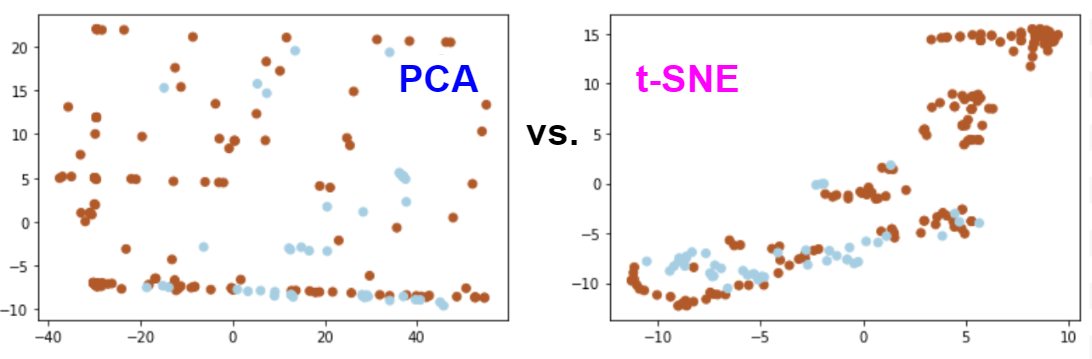
In Part 3, we tried to apply the feature scaling and dimensionality reduction techniques to the dataset with phishing and benign URLs. As a result, we were able to clearly see the distribution of URLs between two classes based on four attributes: registrar, country, lifetime, and protocol.

But what if we don’t have labels (phishing and benign) for the Internet links in the beginning. Will ML still work to detect phishing attacks? In this case, we may come to unsupervised learning, in particular, clustering. Clustering enables grouping objects of unknown classes according to common features so that we do not need labeled data for a training set.

Wednesday, 18 March 2020

AI and Cybersecurity. Part 3 - Dimensionality Reduction and Feature Scaling

In the previous post, we created a binary classifier for detecting phishing URLs. Here, we're going to continue exploring the data with visualization techniques.

Monday, 16 March 2020

AI and Cybersecurity. Part 2 - Detecting Phishing URLs with ML

hack fraud card code computer credit crime cyber data hacker identity information internet password phishing pile privacy protection safety secure spy steal technology thief green cartoon text product line font illustration human behavior angle clip art graphics computer wallpaper

In Part 1, we already got acquainted with AI paradigms and the main ML approaches: supervised, unsupervised, and reinforcement learning. Even though the unsupervised learning approach looks more attractive as you do not need to pre-mark the data for training, supervised learning can be seen as a more precise instrument for detecting malicious objects such as phishing URLs once we have enough labeled data.