Showing posts with label ransomware. Show all posts
Friday, 2 October 2020
Reinforcement Learning for Anti-Ransomware Testing
ML models have recommended themselves as a powerful tool for cyberdefense. AI/ML is heavily used in antiviruses (EDR), Next-Gen Firewalls, and SIEM (SOAR) solutions to solve the classification problem as well as to discover anomalous behavior that may indicate a presence of an attacker with the help of Supervised and Unsupervised Learning. Deep Learning helps to filter spam emails and mark fake news to protect users against disinformation [1].
Monday, 9 December 2019
Analysis of Ryuk Ransomware
[Authors: Viktoria Taran, Alexander Adamov]
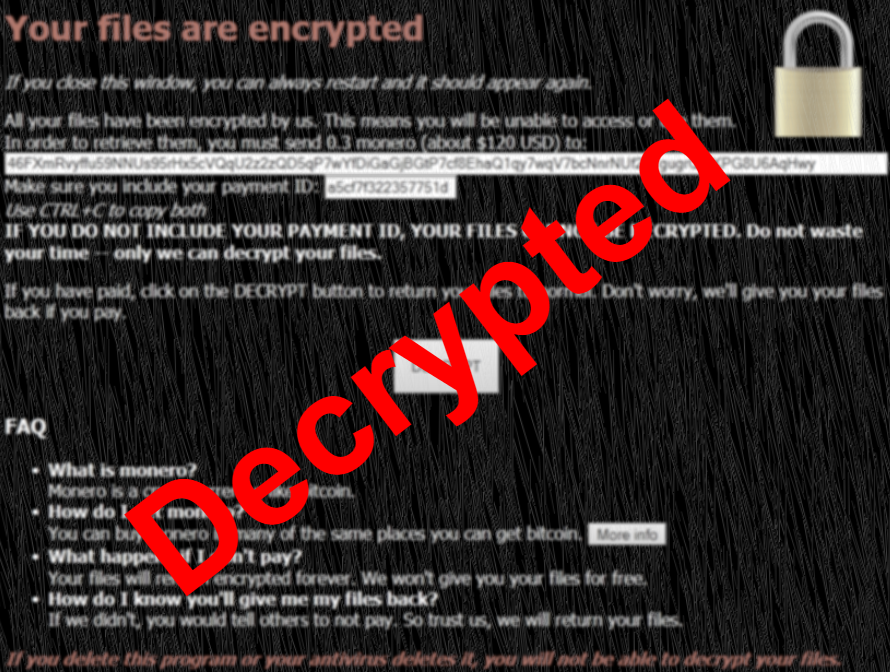
The Ryuk ransomware seen for the first time in August 2018 has been successfully used in targeted attacks encrypting data and asking for a ransom payment which differs from 10 BC to 50 BC. The recent attack was executed against DCH hospitals in Alabama on October 1st, 2019. As a result, DCH paid the ransom to recover the data stored on their servers. In this report, we analyze one of the recent versions of Ryuk ransomware discovering the installation process, networking details, and encryption model.
Sunday, 29 September 2019
GermanWiper: One More Wiper Pretending to Be Ransomware
[Authors: Viktoria Taran, Alexander Adamov]
GermanWiper was first seen on the BleepingComputer forum on July 30, 2019. After analysis, it turned out that the malware is rather a wiper than ransomware. Interestingly, GermanWiper managed to raise $9,000 almost reaching the result of $10,500 (4.13528947 BTC) earned by another wiper called NotPetya in June 2017. Let us take a close look at the ransomware to find out the installation process, communication details, and wiping details.
Saturday, 23 March 2019
Analysis of LockerGoga Ransomware
Norsk Hydro back in 1905.
Source: https://commons.wikimedia.org/wiki/File:Rjukan_fabrikker_-_Norsk_Hydro.jpg
Tuesday, 31 July 2018
VB2018: Artificial intelligence to assist with ransomware cryptanalysis
It's always very exciting for me to be able to attend and, moreover, speak at the Virus Bulletin Conference. Because, it is the oldest and the most respectful antivirus conference that has been running since 1991 where cybersecurity experts from academia and industry gather to share their ideas, research, and forecasts. You can meet the researches who helped to boost the antivirus industry decades ago and are now the core of the antivirus community.
This year in Montreal, we'll present an academic research conducted by my master student Kateryna Vitiuk under my supervision and devoted to Cryptanalysis of ransomware with the help of Artificial Intelligence.
When analyzing ransomware, we often see the hardcoded implementation of the AES, RC4, Salsa20 algorithms, for example in TeslaCrypt, Locky, GlobeImposter, MoneroPay ransomware. The ciphers' code can be poorly detected in the ransomware's memory dumps using the signature-based approach using Krypto ANALyzer (KANAL) for PEiD tool and publicly available Yara rules. Therefore, we assumed that it is possible to use the smart pattern matching method to find the known crypto primitives in the ransomware's disassembled code.
See also:
https://www.virusbulletin.com/conference/vb2018/abstracts/artificial-intelligence-assist-ransomware-cryptanalysis
Wednesday, 21 March 2018
Corporate Backup Solutions Self-Defense Test - March 2018
In the light of the growing number of ransomware attacks in which cryptolockers terminate database processes to unlock the database files for encryption (Cerber, GlobeImposter, Rapid, Serpent) and can encrypt local and network backups to demand a ransom (Rapid, Spora), we decided to test self-defense capabilities of the top backup solutions used in business environments available for trial.
The test aims at testing the sustainability of product’s processes and services against typical attacks to security software described below, as well as self-protection of local backup and product’s files. Ransomware can encrypt local backup files and configuration files that belong to a backup program thereby disabling the recovery of the files. Moreover, once access to agent’s or server’s processes is gained, an attacker can delete backup copies of the files not only locally, but also in the cloud on behalf of a backup solution.
See the full report by the link.
Labels:
Acronis,
Arcserve,
backup,
NioGuard,
ransomware,
self-defense,
test,
Veeam,
Veritas
Sunday, 4 February 2018
Decryptor for MoneroPay Ransomware
After analysis of the MoneroPay ransomware (MD5: 14ea53020b4d0cb5acbea0bf2207f3f6), we managed to patch the binary to turn it into a decryptor.
Friday, 27 October 2017
Bad Rabbit Ransomware or Evolution of NotPetya
BadRabbit launched on the morning of Tuesday, October 24, 2017 was delivered through drive-by downloads of the fake Adobe Flash Player installer from the hacked websites. The installer came undetected with a Symantec digital certificate and 1 out of 65 detection rate on VirusTotal. The Bad Rabbit ransomware having the similar set of features and code snippets to the NotPetya wiper can be considered like its new version supposedly created by the same author. In the new version, the legitimate DiskCryptor driver used to install the bootloader and encrypt the hard disk volumes in a hidden way.
Main outcomes:
- The BadRabbit is a new version of NotPetya, supposedly written by the same author;
- It's a cryptolocker - you can unlock the computer and decrypt the data only by paying 0.05 BTC;
- This is not a targeted attack, unlike NotPetya
- The BadRabbit is distributed over the local network using the EternalRomance vulnerability in SMB1, WMI, WebDAV, brute-force with simple passwords through NTLMSSP
- The BadRabbit uses the legitimate DiskCryptor driver
Thursday, 10 August 2017
Serpent Ransomware Analysis
The new Octopus cryptolocker being an offspring of the Serpent/Zyklon/WildFire/HadesLocker families shows that .NET ransomware can be not an easy meat for a reverse engineer. It leverages several types of obfuscation, code encryption, and anti-debugging to protect its C# code from decompilation and analysis.
Monday, 7 August 2017
Spora Ransomware Analysis
Similar to Cerber (Ferber) ransomware, Spora has its own intricate encryption file format and does not encrypt the whole file. The encryption block size varies depending on a file size.
Friday, 28 July 2017
New variant of Cerber ransomware (Ferber) analyzed
This summer Cerber is on duty. It comes via spear-phishing emails, bypasses antiviruses leveraging polymorphic encryption and API calls obfuscation. The cryptolocker can be easily customized for every target by embedding the JSON-formatted configuration data encrypted with RC4-128 (the decrypted config is on Github for cfd2d6f189b04d42618007fc9c540352). The file encryption scheme 'master RSA-2048 key'-> 'session RSA-880' -> 'file's RC4-128' used by Cerber is not breakable. Cerber scans the IP ranges specified by CIDRs in the config for the C&C server.
Wednesday, 28 June 2017
EternalPetya / NotPetya Ransomware Analysis
Saturday, 3 June 2017
XData ransomware attacked users in Ukraine
On May 18, the author(s) of XData ransomware ran the massive attack against Ukrainian users supposedly leveraging the EternalBlue exploit as well as an ordinary spearphishing email delivery method. A week later, an anonymous user, supposedly the author of AES-NI ransomware the XData is based on, released the master private key. Currently, the XData decryption tools are available. We analysed the XData code and found two host-based 'kill-switches', one of them is about detecting an antivirus running on an infected machine.
Wednesday, 17 May 2017
Ransomware Protection Test - April 2017
During the last decade, ransomware (cryptolockers) show sustainable growth that can be explained by an effective business model that incorporates an anonymous payment system (Bitcoin) and network (TOR). This allows attackers to go untraceable and unpunished in their criminal activities.
In this regard, antiviruses and backup solutions come to protect you against ransomware and eliminate infection consequences. However, based on our incidents investigation experience, most of the ransomware infections in organizations happened with an antivirus installed and turned on. This can be explained by the fact, that the new ransomware variants employ polymorphic encryption with code obfuscation [1], broken PE headers [2], and scripting languages [3, 4]. All these help attackers bypass antivirus signature-based protection giving a chance for behavior blockers and anti-ransomware solutions to come into play. Therefore, it is essential to test security solutions by simulating the real-world ransomware attacks.
First, we tried the RanSim ransomware simulation software made by KnowBe4 [5] to verify if an antivirus can block a ransomware attack. However, RanSim has several limitations. The most principal one is that antiviruses block the RanSim executables underway using simple blacklists before the actual test scenarios are run. The question then arises as to how to bypass antivirus signature protection to run ransomware test scenarios that will test the antivirus behavior blocker or anti-ransomware protection only.
To solve the problem of testing anti-ransomware solutions, we looked into the successful real-world ransomware attacks to find out the techniques that help malware to go unnoticed. As a result, we created the ransomware testing framework called NioCryptoSim [6] written mostly in Python. The test suite includes three false positive tests and 15 tests simulating the base cryptolocker functions as well as complete models imitating the behavior of some real-world ransomware.
As a result, we tested 22 top antiviruses and one backup solution with the anti-ransomware solution from Acronis using the NioCryptoSim testing framework.
See the full report by the link.
Monday, 15 May 2017
WannaCry 2.0: Indicators of Compromise
WannaCry (WannaCryptor) is becoming probably the most popular cryptolocker in the history of ransomware. It has nothing new in terms of files encryption (RSA + AES using MS CryptoAPI) but uses MS17-010 (a.k.a. ETERNALBLUE named by NSA) vulnerability to propagate itself through local networks using the Server Message Block (SMB) protocol as a network worm resulting in thousands of infections of Windows machines that have not been updated so far.
Monday, 3 April 2017
Wednesday, 22 March 2017
Fake bills deliver Crypt0L0cker in Sweden
After revealing the fake emails with finance related information from banks and the Tax Office in Ukraine delivering ransomware, we revealed the similar attack running in Sweden. The archive allegedly with a bill was placed on Dropbox and contains the latest version of Crypt0L0cker (a.k.a. TorrentLocker) inside.
Friday, 17 March 2017
Shade ransomware comes through billing notifications
We are seeing the numerous infections by the new version of the Shade cryptolocker during the last week in Ukraine. The Shade has been leveraging a cheap and effective email delivery channel. The attack is run with the help of fake emails sent on behalf of Ukrainian financial institutions (e.g. PrivatBank, the Ukrainian Tax Office) from the hacked email accounts, most of them belong to organizations in the gov.ua TLD. The subject of these emails is bills or indebtedness that a victim needs to pay.
Thursday, 2 February 2017
Decrypting DeriaLock
Recently, our laboratory analyzed the new version of DeriaLock (MD5: 0a7b70efba0aa93d4bc0857b87ac2fcb).
This version of DeriaLock is unique because of two reasons. First, it demands to pay the 30 USD/EUR ransom to the Skype account. Second, DeriaLock incorporates three types of functionality: SystemLocker, CryptoLocker, and FileKiller within a single attack.
If you managed to remove the DeriaLock infection and keep your encrypted files, you can start now decrypting your documents using the encryption key and initialization vector calculated by our script based on the password string extracted from the analyzed version of DeriaLock:
AES-256 key: 9c9e1ba2ee5b86494b7e1ebba6420ee6ab64ce6d678604eb5b5049b210693743
IV: 9fa4ed4d89b04ee7f3b74c9b46588e18
To decrypt '.deria' files, you can use OpenSSL tool specifying the discovered key and initialization vector. For example:
openssl aes-256-cbc -d -in photo.png.deria -K 9c9e1ba2ee5b86494b7e1ebba6420ee6ab64ce6d678604eb5b5049b210693743 -iv 9fa4ed4d89b04ee7f3b74c9b46588e18 -out photo.pngOr use our Python script or executable to decrypt all '.deria' files that can be found on your computer.
Sunday, 20 December 2015
VaultCrypt: From Russia with Love
During the last several months Ukrainian Cyberpolice recorded many incidents all over the country with VaultCrypt. We decided to shed light on the issue. VaultCrypt is a cryptolocker having the similar to TeslaCrypt scheme using Tor and Bitcoins to pay a ransom, but simpler in implementation.
Subscribe to:
Posts (Atom)