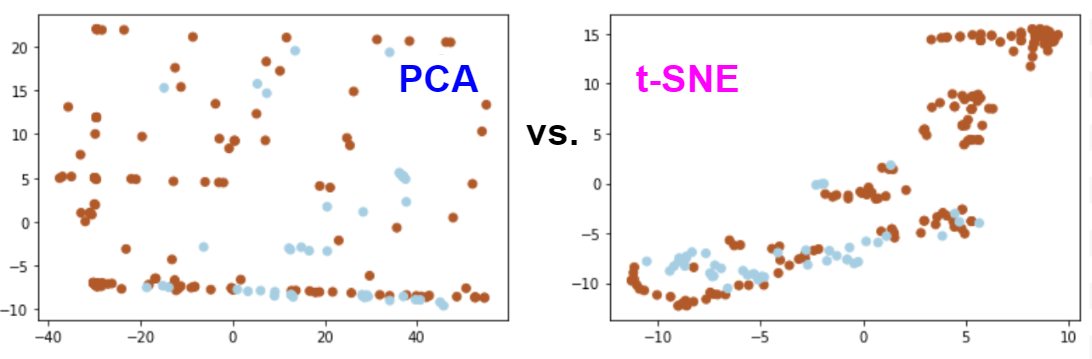
In the previous post, we created a binary classifier for detecting phishing URLs. Here, we're going to continue exploring the data with visualization techniques.
Showing posts with label Artificial Intelligence. Show all posts
Wednesday, 18 March 2020
Monday, 16 March 2020
AI and Cybersecurity. Part 2 - Detecting Phishing URLs with ML

In Part 1, we already got acquainted with AI paradigms and the main ML approaches: supervised, unsupervised, and reinforcement learning. Even though the unsupervised learning approach looks more attractive as you do not need to pre-mark the data for training, supervised learning can be seen as a more precise instrument for detecting malicious objects such as phishing URLs once we have enough labeled data.
Saturday, 14 March 2020
AI and Cybersecurity. Part 1 - Intro
Image via www.vpnsrus.com
[Author: Alexander Adamov]
Foreword
I have spent almost all my professional life working in the antivirus industry detecting and analyzing malware. Around ten years ago, when the malware flow had increased so much that my colleagues and I did not have enough resources to analyze them all, we started thinking about automating our efforts. How to make a machine that autonomously detects and analyzes malware and phishing URLs day and night, writes and publishes reports? As a result, we managed to create a robot (what we call now 'malware sandbox') from scratch to automate most of the processes in the malware laboratory with the help of His Majesty Artificial Intelligence (AI). Since that, we accumulated a bunch of use cases for cyberattacks detection, malware analysis, and security testing with ML that can be useful for cybersecurity professionals that decided to leverage ML for cyberdefense. I'm going to share this knowledge in the series of blog posts that will eventually become a part of a new university course 'ML in Cybersecurity' that I plan to make open-source. I also welcome cybersecurity experts and data scientists to contribute and help universities adopting the course.
Foreword
I have spent almost all my professional life working in the antivirus industry detecting and analyzing malware. Around ten years ago, when the malware flow had increased so much that my colleagues and I did not have enough resources to analyze them all, we started thinking about automating our efforts. How to make a machine that autonomously detects and analyzes malware and phishing URLs day and night, writes and publishes reports? As a result, we managed to create a robot (what we call now 'malware sandbox') from scratch to automate most of the processes in the malware laboratory with the help of His Majesty Artificial Intelligence (AI). Since that, we accumulated a bunch of use cases for cyberattacks detection, malware analysis, and security testing with ML that can be useful for cybersecurity professionals that decided to leverage ML for cyberdefense. I'm going to share this knowledge in the series of blog posts that will eventually become a part of a new university course 'ML in Cybersecurity' that I plan to make open-source. I also welcome cybersecurity experts and data scientists to contribute and help universities adopting the course.
Tuesday, 31 July 2018
VB2018: Artificial intelligence to assist with ransomware cryptanalysis
It's always very exciting for me to be able to attend and, moreover, speak at the Virus Bulletin Conference. Because, it is the oldest and the most respectful antivirus conference that has been running since 1991 where cybersecurity experts from academia and industry gather to share their ideas, research, and forecasts. You can meet the researches who helped to boost the antivirus industry decades ago and are now the core of the antivirus community.
This year in Montreal, we'll present an academic research conducted by my master student Kateryna Vitiuk under my supervision and devoted to Cryptanalysis of ransomware with the help of Artificial Intelligence.
When analyzing ransomware, we often see the hardcoded implementation of the AES, RC4, Salsa20 algorithms, for example in TeslaCrypt, Locky, GlobeImposter, MoneroPay ransomware. The ciphers' code can be poorly detected in the ransomware's memory dumps using the signature-based approach using Krypto ANALyzer (KANAL) for PEiD tool and publicly available Yara rules. Therefore, we assumed that it is possible to use the smart pattern matching method to find the known crypto primitives in the ransomware's disassembled code.
See also:
https://www.virusbulletin.com/conference/vb2018/abstracts/artificial-intelligence-assist-ransomware-cryptanalysis
Subscribe to:
Posts (Atom)

